
A Prediction That Felt Like Confirmation
I watched Peter Diamandis’s latest Moonshots episode and one part felt less like a prediction than confirmation. During the conversation, Emad Mostaque described running 18 persistent AI bots together: named workers with computers, memory, tools, and different responsibilities.
That is materially different from opening 18 chat windows. A chat window waits for a person to supply the next prompt. A persistent teammate can retain context, operate inside an assigned environment, continue a defined loop, coordinate with other workers, and return with completed work or a clear escalation.
It is also the direction I have been trying to build toward with JARVIS, OpenClaw, PEAK, and an experimental Hermes agent running on my desktop.
The Hard Part Is No Longer The Answer
The hard part is no longer getting AI to answer a question. Strong models can already research, summarize, draft, classify, analyze, and write code. The harder problem is creating the operating environment around that intelligence.
An AI teammate needs a reliable place to work, enough context to understand the assignment, tools appropriate to its responsibilities, and boundaries it cannot cross. It needs a shared system where tasks, decisions, sources, evidence, and results remain visible after the conversation ends.
Without that operating layer, agent activity becomes another form of organizational noise: impressive outputs scattered across chats, terminals, documents, and dashboards with no durable ownership or next action.
What A Persistent Teammate Actually Needs
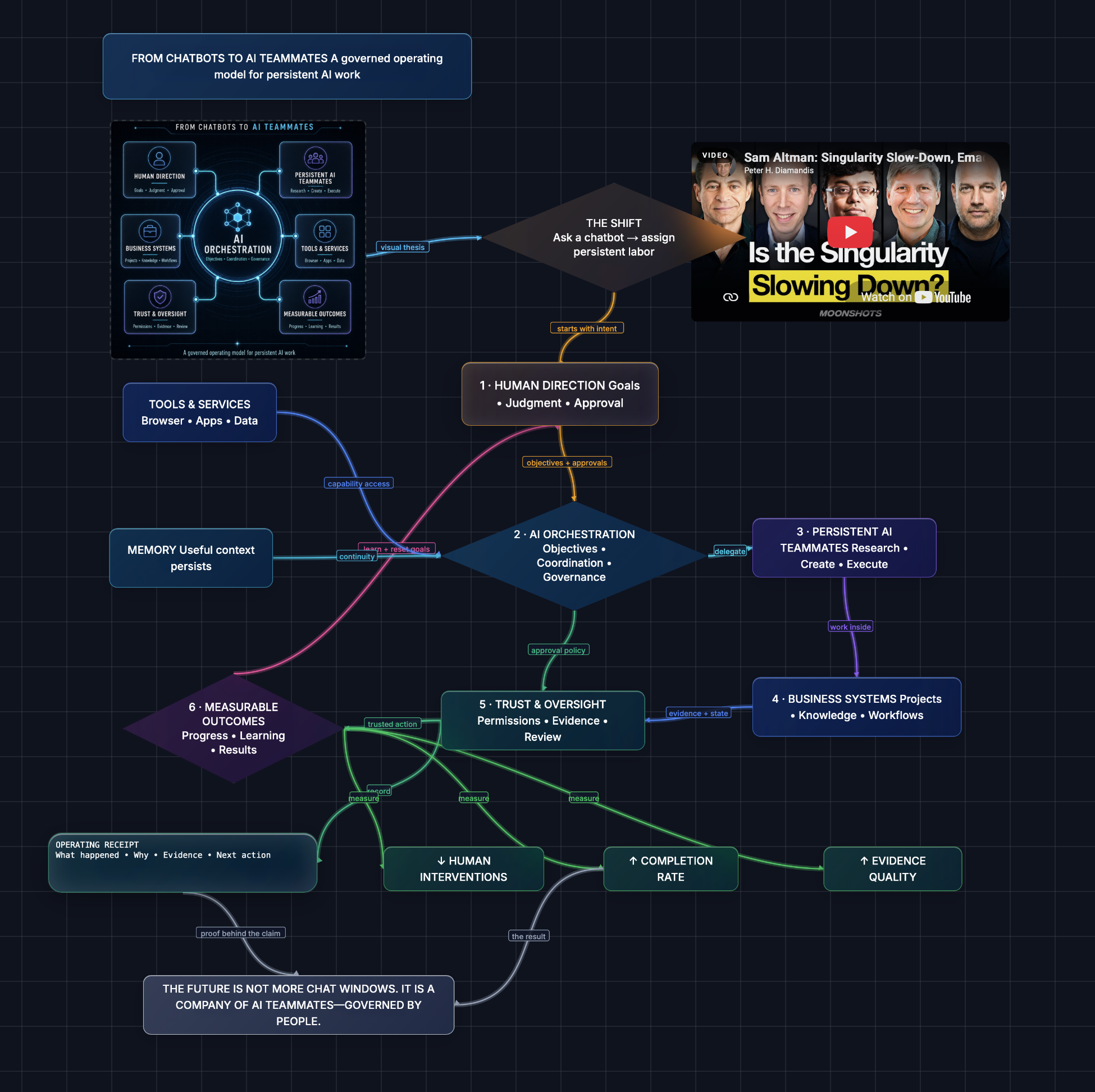
The useful unit is not the bot by itself. It is the complete loop around the bot. That loop has to connect human intent to delegated work and delegated work back to inspectable business outcomes.
- Human direction: clear goals, judgment calls, and explicit approval authority.
- Orchestration: a control layer that assigns work, coordinates specialists, and handles exceptions.
- Persistent context: memory and project state that survive beyond a single conversation.
- Tools and services: scoped access to browsers, applications, files, data, and execution environments.
- Business systems: projects, workflows, documents, and decisions that remain the shared source of truth.
- Trust and oversight: permissions, evidence, review gates, and receipts for consequential actions.
- Measurable outcomes: completion rate, intervention count, evidence quality, speed, cost, and business results.
Small Companies May Feel This First
Persistent AI teammates could change the operating capacity of very small companies before they transform large ones. Small teams have fewer approval layers, less legacy infrastructure, and more obvious gaps between what needs to happen and what the humans can realistically finish.
One useful overnight teammate could prepare research, reconcile project state, draft a morning brief, organize evidence, identify blockers, and place decisions in front of the founder. Several specialized teammates could divide that work across sales, product, operations, content, and customer continuity.
The advantage is not replacing every person. It is allowing a small number of people to operate with more continuity, better preparation, and less dropped context.
The Always-On Computer Problem
Persistent work still needs persistent infrastructure. My current desktop is powerful enough for experimentation, but it is not an efficient 24/7 worker. Running it continuously does not make operational or economic sense.
That creates a practical design question: which capabilities should live on a small always-on computer, which should run in cloud execution environments, and which should remain behind human-controlled devices or browser sessions? The right answer will probably be a hybrid rather than a single machine doing everything.
In the meantime, we are mapping the architecture and testing the operating loops. That lets us learn what persistence actually requires before buying hardware or multiplying agents for the sake of appearance.
A Living Diagram, Not A Marketing Mockup
The diagram accompanying this article was created inside PEAK’s Interactive Builder as part of the actual workflow. It is not a static concept assembled after the fact. The Builder can connect operating-model nodes, source media, memory, governance, metrics, and project evidence in one living workspace.
That matters because the visual itself can become an interface. Today it is a two-dimensional operating map. In the future, the same underlying scene could be rendered through spatial computing, placed around a room, manipulated with hands and voice, and synchronized back to the same projects and decisions.
The deeper idea is not to build a collection of flashy AI surfaces. It is to give the company one durable model of its work that can be rendered as a document, a diagram, a dashboard, or eventually a spatial environment.
What Should Be Waiting In The Morning?
It still feels early and a little wild, but persistent AI teammates are likely to change how small companies operate. The winning systems will not be the ones with the largest number of bots on screen. They will be the ones that reliably turn objectives into useful work while keeping people in control of consequential decisions.
The most practical question is not how many agents a company can run. It is what one trusted teammate could prepare quietly overnight that would make the next morning materially better.
What would you want waiting for you: qualified opportunities, a project brief, customer follow-ups, product research, a content package, a risk review, or something else entirely?